Reviews
Part of Old-house restoration budget categories ranked by volatility
Restoration materials compared for installed cost and long-term upkeep
Roofing, siding, mortar, windows and paint compared on installed cost, service life and yearly upkeep, so the cheap option can be judged over decades.
What to take away
- Compare restoration materials over a service life, not at the point of purchase. A roof that lasts three times as long is not three times the cost.
- Repairing an existing material is nearly always cheaper than replacing it in kind, and often cheaper than replacing it with something lesser.
- Upkeep is part of the price. Low-maintenance claims usually mean not maintainable rather than never failing.
- Compatibility matters more than performance. A stronger material next to a softer historic one damages the softer one.
- Prices below are typical US figures for 2026. Access, region and substrate condition move them more than brand does.
The cheapest material at the checkout is often the most expensive over thirty years. Natural slate costs two to six times as much as asphalt to install, then outlasts several asphalt roofs. The tables below put installed cost, service life and yearly upkeep side by side.
Roofing
Installed cost, 2026 typical
- Natural slate (Vermont, Buckingham)
- $20 to $45 per sq ft
- Clay tile (Ludowici and similar)
- $15 to $30 per sq ft
- Standing seam metal (24-gauge steel, Kynar 500 finish)
- $12 to $20 per sq ft
- Wood shingle (western red cedar)
- $8 to $14 per sq ft
- Asphalt shingle (GAF Timberline HDZ, Owens Corning Duration)
- $4.50 to $7.50 per sq ft
Service life
- Natural slate (Vermont, Buckingham)
- 75 to 150 years
- Clay tile (Ludowici and similar)
- 50 to 100 years
- Standing seam metal (24-gauge steel, Kynar 500 finish)
- 40 to 70 years
- Wood shingle (western red cedar)
- 25 to 40 years
- Asphalt shingle (GAF Timberline HDZ, Owens Corning Duration)
- 15 to 30 years
Upkeep
- Natural slate (Vermont, Buckingham)
- $25 to $75 per replacement slate
- Clay tile (Ludowici and similar)
- Individual tile repair
- Standing seam metal (24-gauge steel, Kynar 500 finish)
- Low
- Wood shingle (western red cedar)
- Keep clear of debris
- Asphalt shingle (GAF Timberline HDZ, Owens Corning Duration)
- None, then replace entirely
Notes
- Natural slate (Vermont, Buckingham)
- Repairable indefinitely if the framing carries it
- Clay tile (Ludowici and similar)
- Breakage during other roof work is the main risk
- Standing seam metal (24-gauge steel, Kynar 500 finish)
- Detailing at penetrations is what fails
- Wood shingle (western red cedar)
- Fire rules vary by jurisdiction
- Asphalt shingle (GAF Timberline HDZ, Owens Corning Duration)
- Cheapest install, not repairable in kind
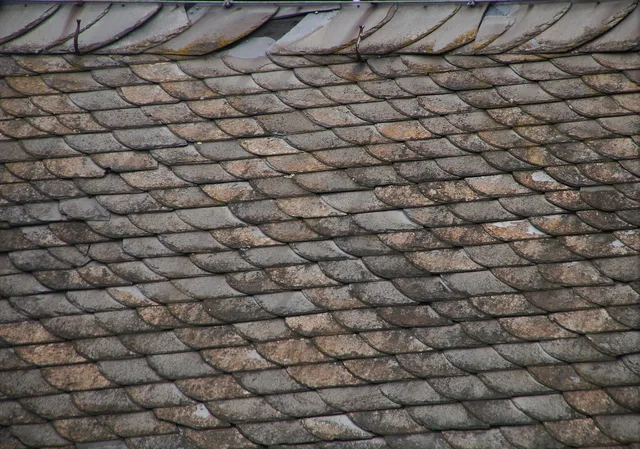
The repair-versus-replace question on a slate roof is worth understanding before anyone quotes a tear-off. The Park Service bulletin on treatment of historic slate roofs explains why partial replacement of failed slates is usually the right treatment, not wholesale removal.
A slate crew typically charges $25 to $75 per slate. Staging and a lift add a minimum visit charge of $500 to $1,500, so owners group repairs into one job.
Roofing materials compared
Material
- Slate
- Very long
- Clay tile
- Very long
- Wood shingle
- Moderate
- Standing seam metal
- Long
- Asphalt shingle
- Short to moderate
Service life
- Slate
- Low, occasional replacement
- Clay tile
- Low, individual tile repair
- Wood shingle
- Moderate, keep clear
- Standing seam metal
- Low
- Asphalt shingle
- Low, then replace
Upkeep
- Slate
- Clay tile
- Wood shingle
- Standing seam metal
- Asphalt shingle
Clay tile works the same way. The federal procedure for clay roof tile repair and reattachment describes reattaching sound tiles rather than stripping a roof because a percentage have slipped.
Both documents make the same point: on long-life roofing, the labor is in the repair, and the repair keeps the material. Reattaching sound tile typically costs $15 to $40 per tile plus staging, against $15 to $30 per square foot for new tile.
Masonry and mortar
Mortar should be weaker than the units it joins. A hard cement mortar in a soft brick wall moves stress into the brick faces, which then spall during freeze-thaw cycles. The mortar is meant to be the sacrificial element.
Repointing with a compatible mix costs more per foot and prevents a much larger repair later. Expect $10 to $30 per square foot of wall face, or $4 to $9 per linear foot of joint, in most US markets.
Scaffolding, joint width and raking depth drive that figure. The usual specification is a natural hydraulic lime such as Saint-Astier NHL 3.5, or a putty mix matched to the original brick.
The same logic governs cleaning and coating. Abrasive cleaning opens the fired surface of brick and speeds up every later problem. Water-repellent coatings hold moisture inside a wall designed to dry outward. Both are sold as protective, and both shorten the life of the wall.
Applied costs follow the pattern. A water-repellent coating typically runs $1 to $3 per square foot, and abrasive or chemical cleaning runs $2 to $6. Hand washing with bristle brushes and a poultice sits at the low end and does less harm.
On masonry, the cheapest long-term policy is usually good rainwater management and the gentlest cleaning method that works. Interior stone and tile suffer from the same instinct, and the cleaning mistakes that undo good work are mostly about strength rather than effort.
Windows and siding
- Original wood sashrepairable indefinitely, needs paint and glazing maintenance, retains old-growth material. Epoxy repair with Abatron LiquidWood and WoodEpox, plus new putty such as Sarco, typically costs $300 to $900 per window; a restoration shop charges $600 to $1,500.
- Replacement unitsshorter service life, sealed units fail, individual parts rarely replaceable. Insert replacements run $450 to $900 installed in vinyl and $900 to $1,800 in wood.
- Wood sidingrepairable board by board, needs paint on a cycle. Cedar clapboard installed runs $8 to $14 per square foot, with repainting every 7 to 10 years at $1.50 to $3.50 per square foot.
- Substitute claddings: hide the wall, trap moisture, and defer rather than remove the problem. Vinyl runs $4 to $9 per square foot installed; fiber cement such as James Hardie runs $10 to $18 and holds paint 10 to 15 years.
The upkeep column is where these flip. Painting on a cycle looks like a burden until you compare it with replacing an entire assembly.
Comparing honestly
Price each option over the same period, including the second replacement of the shorter-lived one and the maintenance of the longer-lived one.
A 2,000 square foot roof in asphalt at $6 per square foot costs about $12,000 and needs replacing two or three times in 60 years. The same roof in slate at $25 per square foot costs about $50,000 and mostly needs spot repairs.
Where those numbers sit in a full project budget is set out in our restoration budget breakdown, and the estimating method is in how to build a restoration estimate.