Industry
Part of Judging historic home materials: four properties that decide every repair
Historic building materials: five lessons restoration crews keep learning
Five lessons about old-house materials: learn from other building types, match softness, source early, keep offcuts, and record what you cannot identify.
What to take away
- Other building types teach material behavior faster than houses do, because their materials are exposed and unpainted.
- Match softness downward. A repair should be no harder than what it joins.
- Source matching material before the crew is booked. Availability sets the schedule.
- Keep labeled offcuts of everything. The next repair depends on them.
Material lessons are learned expensively or borrowed cheaply. These five are all borrowable, and two of them involve looking at buildings that are not houses at all.
One: learn stone from cemeteries
A historic cemetery is an outdoor laboratory of stone weathering, with dated samples. Marble, slate, sandstone, limestone and granite sit side by side, exposed for a century or more, with the year carved on each one.
The Park Service brief on preserving grave markers in historic cemeteries is an unexpectedly good primer for houseowners for exactly this reason. It covers how different stones deteriorate, how cleaning damages them, and why gentle methods win. Walk a local cemetery with it and you will read your own masonry differently.
Two: learn structure from barns
Agricultural buildings carry their construction on the outside. Sills, joints, bracing, siding and roof structure are visible in a way they never are in a finished house, and the failures are visible too: rotted sill ends, racked frames, roofs that let water into the structural system.
The Park Service introduction to rehabilitating historic barns covers roof, foundation and structural repair in terms that transfer directly to a timber-framed house, including the point that a replacement roof should match historically or at least suit the building's character.
Three: match softness downward
Match softness downward
| Original | Repair should be |
|---|---|
| Soft handmade brick | Softer lime-based mortar |
| Old-growth softwood | Similar species and density where possible |
| Lime plaster | Lime or a compatible soft gypsum mix |
| Soft sandstone | Patch material no harder than the stone |
| Original glass | Retain wherever the pane is sound |
The rule has one direction: a softer repair may fail sooner, while a harder repair may damage the original. If a repair fails before the wall, that is an inconvenience. If it outlasts the wall by destroying it, that is a different order of problem, and it keeps happening.
Testing hardness before buying quantity is the whole point of a documented trial on the actual substrate.
Four: source before you schedule
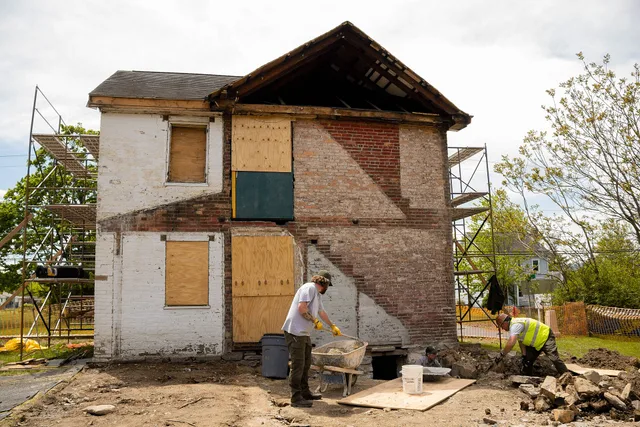
Matching brick, slate, stone, turned parts, moldings and hardware takes time to find. The search often turns up something better than the compromise you were about to accept.
Start looking as soon as the scope is known, and do not book labor until the material has a confirmed date.
Watch salvage yards, architectural salvage dealers and demolition notices continuously, rather than only when you need something.
Five: keep the offcuts
Label and store leftover trim, tile, slate, brick, flooring and hardware in a dry place. Note where each came from. Ten years later, when a section fails, an exact match is sitting in the basement instead of being unavailable at any price.
The framework for identifying what you have is in what to look for when reviewing historic materials, and the interior version of these lessons is in five lessons from period interior projects.