Features
Why do Saint John and St. John's wood row houses fail in Atlantic weather?
Old-house restoration in Saint John and St. John's fails where wind-driven rain meets wood row houses; here is how rot starts and how weather-tight repair works.
What to take away
- Wind-driven rain gets behind siding and paint, and the wall cannot dry. That failure explains most rot in the wood row houses of Saint John and St. John's.
- Rot appears at sill plates, bottom clapboard courses, window sills, porch posts, roof-to-wall flashing and overflowing eavestroughs.
- Repair runs top to bottomroof and gutters, wall envelope, windows and doors, then paint.
- Match the original species and use salt-resistant fasteners. Cedar for exposed sills and lower courses, white pine above the splash zone, never spruce at grade.
- This is Canadian content. Saint John sits in New Brunswick and St. John's in Newfoundland and Labrador, so provincial heritage permits govern the work.
Where the water gets in
Saint John and St. John's sit about 600 miles (1,000 km) apart, and their wood row houses fail in the same way.
Both take North Atlantic weather: heavy rain, freeze-thaw cycling, salt fog and wind that pushes water sideways.
A 19th-century row house wall is thin: clapboard over sheathing, framing and plaster, with no drainage plane. Water that passes the paint stays against the wood, and freeze-thaw opens the joints further.
Saint John's row stock grew around the harbour and uptown after the Great Fire of 1877. St. John's has dense wooden rows off Water Street and more wind and salt, so paint films break down faster there.
Where rot starts in a row house
The pattern repeats from project to project, so you can inspect with purpose.
| Location | Why it fails | What to check |
|---|---|---|
| Sill plate | Splash-back and snow sit against it for weeks | Probe the wall base with a screwdriver |
| Bottom clapboard courses | Rain rebounds off steps and pavement | Look for checked boards and lifted paint |
| Window sill and bottom rail | Water pools, finds a joint, enters the rough opening | Confirm the sill slopes outward |
| Porch and newel posts | End grain near grade wicks water up | Check wood within 12 inches (300 mm) of soil |
| Eavestrough and downspout | Overflow sheets water down the wall | Look for stains under the gutter line |
Party walls spread the problem. Water entering one unit crosses the shared cavity and shows up next door, so rot on one side usually means the neighbour has it too. It is one of the mistakes that quietly damage old houses.
Mould follows rot, so opening a damp wall is a health task before it is a carpentry one. The Canadian Centre for Occupational Health and Safety sets out the exposure risks in its health hazards guidance.
Example: the St. John's sill that rotted twice
A north-facing wall shows blistering paint and a soft sill. The owner replaces the sill, repaints, and calls the job finished.
Two winters later the new sill is soft again. The cause sits higher up: an overflowing eavestrough sheets water down that face, and the sill takes the beating.
The repair that lasts starts at the gutter, then the wall, then the sill.
Repair order that keeps water out
Water arrives from above, so the top of the building is fixed first.
- Roof and gutters. Repair flashing at valleys, chimneys and roof-to-wall junctions. Clear and re-pitch eavestroughs, and send downspouts clear of the wall.
- Wall envelope. Strip failed siding and sheathing, replace rotted framing, and add a drainage plane while the wall is open. Flash every penetration.
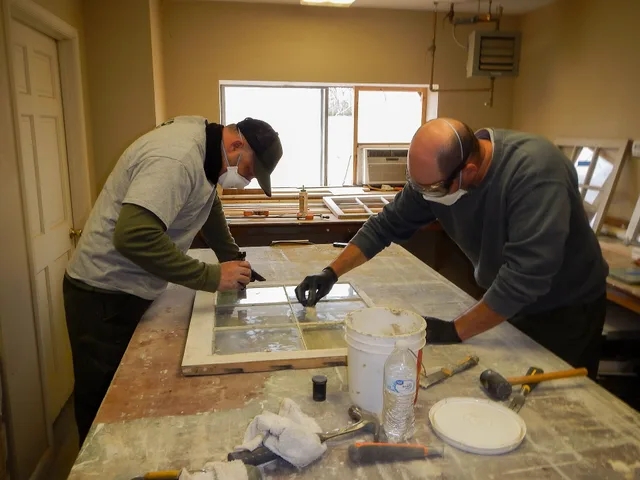
- Windows and doors. Rebuild sills, re-glaze and re-flash the rough openings. Winter details are in restoring original wood windows for a Canadian freeze-thaw winter.
- Paint. Prime bare wood, caulk open joints, and apply the finish coat only to dry wood.
Step two is where projects go wrong. Crews replace visible rot and close the wall before confirming the water path.
Wood, fasteners and paint for salt and freeze-thaw
Eastern white cedar is the best exposed wood in this climate. It takes paint and resists decay, which is why it goes into sills, thresholds and lower courses.
Eastern white pine was common in 19th-century work. It takes paint and has little decay resistance, so keep it above the splash zone.
Spruce served as framing and sheathing and rots quickly when wet, so pressure-treated lumber belongs in hidden structural repairs only, never in visible trim.
Use stainless steel or hot-dip galvanized fasteners near the coast. Electroplated ones fail within a few years. The same salt attacks masonry and joinery, as Halifax salt air changes masonry and window care explains.
Paint should let the wall dry outward. Paint failure causes and suitable finishes are covered in the NPS guidance on paint problems.
Repairs that disturb painted siding on a pre-1978 house trigger lead-safe work practices, spelled out in the EPA Renovation, Repair and Painting rules.
US readers: the mechanism is the same in New England and Pacific Northwest wood rows. The rules differ. Pre-1978 homes fall under EPA lead rules, state historic preservation offices issue permits, and the National Park Service runs the rehabilitation tax credit.
Spring and fall inspections
Two visits a year catch most failures. Spring finds winter damage, and fall prepares the wall for freeze-thaw.
Spring:
- Paint blistering or peeling, especially north and east walls
- Soft wood at sills, clapboard bases and porch posts
- Overflow stains under eavestroughs
- New interior stains after heavy rain
Fall:
- Clear eavestroughs and downspouts before the first freeze
- Re-caulk joints at windows, doors and corners
- Check flashing at chimneys, valleys and roof-to-wall junctions
- Confirm ground slopes away from the wall
Grading that slopes toward the building, or a downspout that dumps at the foundation, shows up inside as foundation problems, not as a wall leak.
Finding trades and permits for row house repair
Weather-tight repair draws on carpenters, roofers, sheet metal workers, glaziers and painters. Heritage carpentry is the core skill, so ask which species and profile they will use and how they will handle the drainage plane.
The Canadian Association of Heritage Professionals keeps a directory of accredited members. Provincial programs, such as Nova Scotia's Department of Growth and Development, publish grant and permit details. Municipal heritage officers can name crews who have worked in local districts.
Get three recent projects on wood row houses in the same city, insurance and workers' compensation coverage, and a written scope covering extra rot.