Guides
Plaster repair in century homes, what Ontario and Quebec crews see
Plaster repair in Ontario and Quebec turns on lath failure, horsehair plaster, and heating cycles that push century walls harder than milder climates do.
What to take away
- Lath failure is a moisture and movement story. A single bad batch of plaster almost never explains a wall that has let go.
- Sound the wall by tapping before you price anything. The hollow map, not the visible crack, is the scope of work.
- Horsehair plaster still gets matched by hand in both provinces, because lime and hair behave nothing like bagged patching compound.
- Central Canada's heating cycle drives most seasonal cracking, and the swing is wider than in coastal or southern climates.
- Sequence mattersstabilize, re-key, then finish. Wholesale removal in a masonry building can disturb the backing and may need a heritage permit.
What the building stock tells you before you open a wall
A stone farmhouse outside Guelph and a brick row in Montreal's Plateau were framed by different trades, with different lath, and they fail differently. Ontario's Victorian and Edwardian stock leans on brick veneer over wood frame, with split lath and three-coat lime plaster inside.
Quebec's urban stock includes stone rubble walls and a long tradition of plaster laid directly over masonry, which changes how moisture moves through the assembly.
Before you cut, establish four things: the framing date, the lath type, the number of plaster coats, and the current heating and ventilation setup. Those four answers predict most of what you will find behind the surface.
Heritage status changes the sequence. Ontario's Heritage Act and Quebec's Cultural Heritage Act both give municipalities tools to regulate alteration, and Quebec culture and heritage context shapes how local patrimoine files are assessed. If the property sits on a municipal heritage register, a permit may be required before you touch interior plaster in a designated space.
Quebec housing and territory services also touch renovation files where a project meets tenancy, zoning or bylaw enforcement. Know which office holds jurisdiction before you promise a start date.
One more thing: most century homes here have been re-plumbed, re-wired and re-roofed at least once. Those penetrations, not the original work, are where current damage usually starts. The mechanics of what happens when a crew opens a wall are covered in this explainer on plaster wall repair, which walks through keys, coats and curing.
Lath failure: why it happens and how it reads by region
Lath failure is the loss of the mechanical key between plaster and its backing. The plaster stops gripping the wood or the masonry, and gravity plus vibration finish the job.
Three mechanisms dominate. Moisture cycling swells and shrinks the lath, and split lath moves more than sawn. Movement in the structure, from foundation settlement to floor deflection, cracks the keys. And the plaster itself loses cohesion as lime carbonates over a century and the aggregate weakens.
The pattern differs by region. In Ontario you often see long horizontal cracks at ceiling perimeters and around stairwells, because the framing moves seasonally and the plaster sits thin over the lath. In Quebec's masonry buildings you more often see delamination in sheets, with plaster separating cleanly from a stone or brick backing that has taken on moisture.
A third pattern shows up in both provinces: the re-keyed patch that failed. Someone patched with a hard, gypsum-rich compound over a soft lime base. It holds a few years, then pulls the surrounding lime away as it shrinks.
Sound the wall before you decide anything. A light tap with a knuckle or a screwdriver handle maps the hollow zones in minutes. Mark them.
Lath itself can often be saved. Split lath that is sound but loose can be re-secured with screws and washers, provided the wood is not rotten. Rot means replacement, and replacement puts you in a rebuild conversation.
Opening old plaster releases fine silica and lime dust, and damp cavities can carry mould. The hazards are documented in CCOHS health hazard controls, and the controls, extraction, wet methods and respiratory protection, are not optional on a century home.
Horsehair plaster and the mixes crews still match
Horsehair plaster is lime plaster reinforced with animal hair, usually from horses, sometimes cattle. The hair acts as a tensile web, holding the plaster together across cracks and giving it flex.
You will find it in both provinces, but the mixes differ. Ontario urban work often used a coarser scratch coat with more sand and shorter hair. Quebec work in masonry buildings tends to run a slightly richer lime mix with longer hair, because the backing moves differently.
The hair is not decorative. Remove it and patch with a modern compound, and you remove the crack-bridging capacity of the wall. That is why so many patched century walls crack again within two winters.
Matching the mix is craft, not recipe. A workable starting point for a lime base coat is one part hydrated lime to two or three parts well-graded sand, with hair added at roughly a handful per bucket, enough to bind when you pull a sample apart. Adjust for the existing wall, not for a bag.
Test panels matter. Apply a small patch, let it cure under the same conditions as the wall, and check for shrinkage and bond before committing to a full room.
Finishes carry their own handling rules. Lime, solvents and lead-containing coatings in older homes all fall under workplace chemical rules, and the safety data sheet system that governs them is set out in CCOHS WHMIS and SDS rules.
Read the sheets before you open the pail.
If you are weighing which patches to do first, the ranking logic in this piece on plaster repairs worth doing first filters a tight budget.
How heating cycles drive plaster movement
Central Canada runs a hard heating cycle. Indoor air dries out through winter, picks up moisture in summer, and the wall assembly follows. Plaster, lath and framing each respond at a different rate.
That mismatch is the engine of seasonal cracking. Lime plaster is relatively forgiving because it moves and re-cures, but it is not immune, and the wider the swing, the faster the keys fatigue.
Forced-air heating makes it worse in a specific way. It pressurizes and depressurizes rooms, drives air through every crack and penetration, and carries fine dust into the wall cavity. Over years that dust settles on lath and reduces the grip of the plaster.
Humidity control is the cheapest intervention available. Holding indoor relative humidity in a moderate band through winter reduces the shrinkage half of the cycle. It does not fix lath failure, but it slows the rate at which new failure appears.
Ventilation matters as much. Bathroom and kitchen exhaust that discharges into an attic or wall cavity is common in older Ontario and Quebec homes, and it puts moisture directly where the plaster is weakest. The repair choices that follow from freeze-thaw winters are not the same as those for a dry interior crack.
Repair sequences that differ from US and UK practice
US guidance often assumes wood-framed, gypsum-era construction and treats plaster as a substrate to skim or replace. UK guidance assumes solid masonry and a strong lime tradition, with breathability as the organizing principle.
Ontario and Quebec practice sits between those poles. You get masonry backings in Quebec and framed assemblies across much of Ontario, sometimes in the same city block, and a heating cycle that neither US nor UK literature treats as the dominant driver.
The practical difference is order of operations. Many US guides run remove, replace, finish. Central Canadian work more often runs stabilize, re-key, then finish, because wholesale removal in a masonry building can disturb the backing and heritage controls may limit removal.
A second difference is lath. US practice frequently replaces lath with a modern substrate. Ontario and Quebec crews more often re-secure original lath and re-key it, because the lath is part of the assembly's moisture behaviour.
A third is curing time. Lime needs time and moisture to cure, and in a dry heated interior that means deliberate damping and slower schedules. UK crews know this. US crews often do not, so central Canadian crews plan for it explicitly.
A sequence that works on a typical century home in either province:
Repair sequences
- Document the wallphotographs, hollow map, moisture readings, heritage register status.
- Isolate the room and control dust at the source with extraction and containment.
- Remove only unsound plaster, cutting back to a sound edge and undercutting it slightly.
- Re-secure loose lath with screws and washers, replacing only rotten or broken lath.
- Re-key the backing with a scratch coat matching the original mix and hair content.
- Build out the brown coat, then the finish coat, damping between coats as needed.
- Cure slowly, then inspect after one full heating season before closing out the job.
A patch that looks perfect in October can show a hairline map by February. Referencing recognized construction and trades standards in your scope and your contract is normal practice, and the framework for those standards is summarized in CCOHS standards for trades.
It gives you something concrete to hold a subcontractor to.
Moisture, salts and the calls that follow
Moisture is the most common reason a plaster call comes in, and the most commonly misdiagnosed. The visible crack is a symptom. The source is usually elsewhere.
Four sources account for most of it in central Canada: roof and flashing failures, foundation and grading problems, interior plumbing leaks, and vapour movement through masonry. Each leaves a different pattern on the wall.
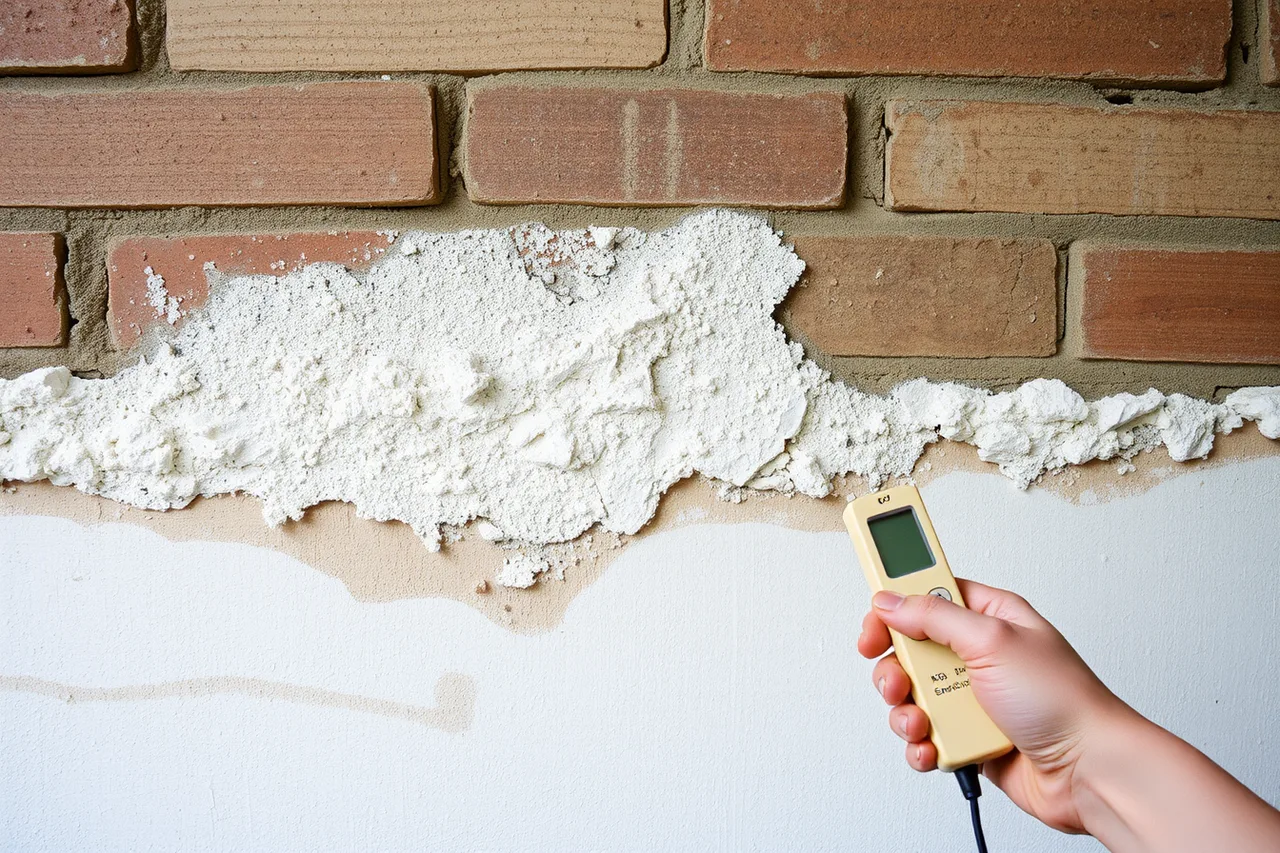
Salts are the tell. Efflorescence, the white powdery deposit, means water is moving through masonry and evaporating at the surface. It often appears with a band of crumbling plaster just below, because salt crystallization breaks the plaster's cohesion.
Salt damage cannot be patched over. Stop the water first, remove the contaminated plaster, then re-plaster once the wall has dried. Patching early guarantees a repeat call.
Mould is the other common finding. Damp cavities behind failed plaster support mould growth, and disturbing it without controls spreads spores through the house.
The health hazards and control expectations are set out in the CCOHS material cited above, and they apply in full on a century wall.
Where a moisture problem is really a building envelope or bylaw issue, the fix may fall under a different permit stream, which is where Quebec's housing and territory services come in.
For owners planning past the current repair, a written plaster wall repair maintenance schedule, covering seasonal humidity checks and an annual hollow-tap survey, catches new failure while it is still small.
When to repair, when to stabilize, when to rebuild
Repair means the plaster is sound, the keys are intact, and the defect is local: a crack, a small hole, a failed patch.
Stabilize means the plaster is largely sound but the keys are compromised over a wider area. You re-secure lath, re-key the backing, and consolidate the existing surface rather than replacing it. This is the most common correct answer in century homes.
Rebuild means the plaster has lost cohesion, the lath is rotten or broken across a large area, or moisture damage is ongoing and the assembly cannot dry. At that point patching is wasted money.
A decision checklist helps:
- Is the plaster sound when tapped, or hollow over more than a small patch?
- Is the lath wood sound, or does it crumble or flex under light pressure?
- Is there active moisture, efflorescence or a musty smell?
- Is the wall on a heritage register, and does the scope need a permit?
- Has the heating and ventilation setup been reviewed for humidity control?
- Is the budget for a full room, or for one wall at a time?
Worked example. A 1908 brick semi in Toronto, plaster hollow across a bedroom ceiling and one wall, no efflorescence, forced-air heat, no heritage designation. The correct call is stabilize: re-secure lath, re-key, skim the affected areas, and address attic ventilation. Rebuilding the whole ceiling would cost several times more and gain little.
Worked example, second case. A stone row house in Montreal, plaster delaminating in sheets, efflorescence along the lower wall, musty smell. The correct call is neither repair nor stabilize yet. Find and fix the water source, let the wall dry, then rebuild the affected section with a matched lime mix. Patching first would fail within a season.
The pattern across both provinces is consistent. Moisture and movement decide the category, and the category decides the sequence.
Photograph everything, keep your moisture readings, and note the mix you used. The next owner or crew will need it, and so will you if the wall is opened again. For the field lessons that recur across real jobs, this collection of plaster repair lessons covers the patterns worth watching.
Common questions
Why does horsehair plaster crack differently from modern plaster?
The hair gives the lime a tensile web, so it holds together across small movements instead of cracking cleanly. When it finally fails, it tends to delaminate in sheets rather than snap in a line.
Can I patch a century wall with modern joint compound?
You can, but it usually fails within a few heating seasons. Modern compounds are harder and shrink differently from lime, so they pull away from the surrounding plaster as the wall moves.
How do I know if my lath has failed?
Tap the wall. A hollow sound over a wide area means the keys are gone. Small hollow spots are normal in old plaster and can often be re-keyed without removal.
Does a heritage designation stop me from repairing plaster?
Not usually, but it can require a permit or a review before alteration. Check the municipal heritage register and the relevant provincial act before work starts.