Maintenance
Part of Historic Home Restoration Mistakes to Avoid
How US homeowners reverse bad old-house repairs
US homeowners can reverse some old-house repairs, but not lost masonry or original fabric. Learn what removal, repair, and replacement involve.
What to take away
- Some damage is permanentabrasive cleaning removes original masonry surfaces, and replicas cannot become original trim or hardware.
- Some alterations, such as cladding and porch infill, can be removed, but only surviving original fabric can be retained.
- Reversal should begin with a small test area and the gentlest effective method.
- Managing water well reduces the harm from damage you cannot undo.
For US homeowners living with inherited old-house repairs, this guide explains what can be reversed, what cannot, and what the work involves. The answer depends on whether original material survives: coatings and additions may come off, but an abraded stone face or missing original fabric cannot be recovered.
Cement pointing on soft masonry
Remove cement mortar mechanically, one joint at a time, using a hand-held joint raker or narrow plugging chisel and small hammer. Keep the tool within the joint and avoid nicking brick arrises. The National Park Service's Preservation Brief 2, Repointing Mortar Joints in Historic Masonry Buildings, explains careful removal and mortar compatibility. Follow repointing with a mortar matched to the original in strength, color, and profile; match aggregate and texture, too. There is no universal mix ratio or lime percentage: base the mortar composition on examination of surviving mortar and the masonry. The replacement should be compatible with the units and not harder or less vapor-permeable than them. Power tools are used carefully or not at all, because a blade that touches a brick arris leaves a permanent chip.
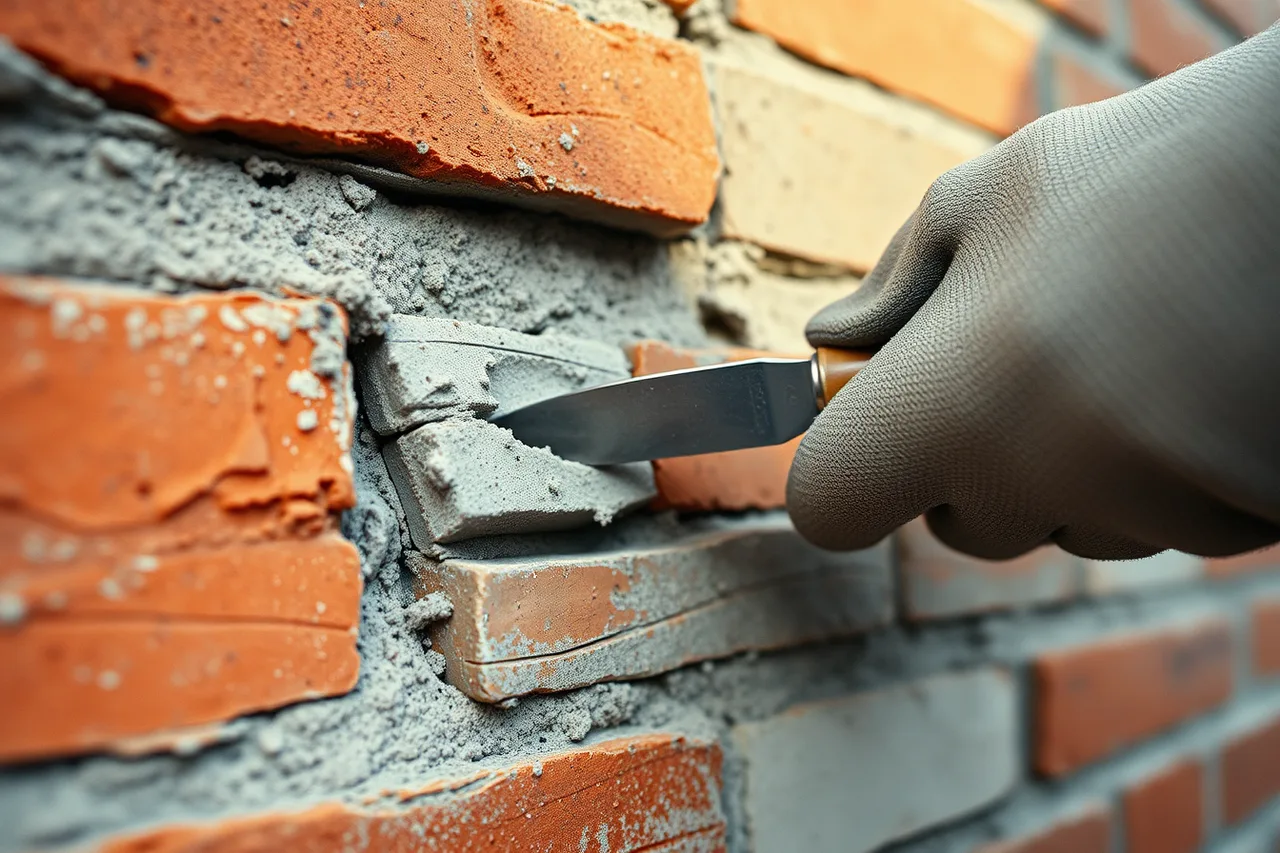
Removal is slow because each joint is cleared individually. The work is often phased by elevation over several years, starting with the elevation that gets the most weather.
A sample area is the right way to assess the work before proceeding. Have a mason clear and repoint a small section, then look at the result after a season. The test shows whether the mortar's appearance matches and whether the brick edges survive the removal method.
Damaged and eroded stone
Where units have spalled, lost their face, or been eroded by harsh cleaning, you have three repair choices. Patch with a compatible mortar, cut in a matching piece, or replace the unit.
The U.S. General Services Administration (GSA) technical procedure for sandstone patching describes the middle path. It sets out surface preparation, patching-material compatibility, and how to finish the repair to match surrounding stone.
Patching can restore profile and protect the stone, but the original surface is gone for good. Sandblasting is a clear example: abrasive cleaning removes the original masonry surface, which a patch cannot recreate. The National Park Service's Preservation Brief 6, Dangers of Abrasive Cleaning to Historic Buildings, explains this risk.
Over-painted and neglected ironwork
Railings, fences, area gratings and porch columns often carry decades of paint over active rust. Painting again over that seals in the corrosion. The proper sequence is removal of failed coatings, treatment of the corrosion, and a compatible coating system.
The U.S. General Services Administration's technical procedure for stripping and repainting iron and steel features is a guide to the sequence. The same holds for painted woodwork, where preparation is what decides whether a finish lasts five years or fifteen.
Other inherited alterations
Cladding over wood siding is usually removable. Test an inconspicuous area, then remove the cladding and fasteners carefully so the original siding is not torn up. Repair damaged boards with compatible wood and match the existing profile; removing cladding cannot restore siding that has rotted or been cut away.
Removed trim and hardware do not come back unless they were saved and remain usable. If a surviving piece or reliable documentation establishes the original profile, a carpenter or metalsmith can make a replica. A replica replaces a missing feature but is not original material.
If cavity insulation is contributing to damp, it can be removed by opening the affected wall and clearing the cavity. First identify and correct the water-entry or drainage problem; removing insulation alone does not stop damp. Inspect a small area before deciding whether more of the wall needs to be opened.
An enclosed porch is often reversible when original posts, trim, windows, or openings remain. Remove later infill and fasteners carefully, repair surviving features, and reconstruct missing elements only when physical evidence supports the design. If original features were removed, taking down the enclosure cannot bring them back.
What can and cannot be reversed
| Inherited problem | Reversible? |
|---|---|
| Cement pointing | Yes, by hand, slowly |
| Water-repellent coating on masonry | Partly, and results vary |
| Cladding over wood siding | Yes, with unknown repairs beneath |
| Sandblasted masonry surface | No |
| Removed original trim and hardware | Only by replication |
| Cavity insulation causing damp | Yes, by removal and reassessment |
| Enclosed porch | Usually, with traces |
The table is only a starting point. Cladding and porch infill can often be removed, and cavity insulation can be cleared from an affected wall. By contrast, sandblasted masonry surfaces and missing original trim or hardware cannot be restored as original; repairs or replicas can only address the resulting damage or loss.
When you cannot undo it
Manage the water instead. Good gutters, correct downspout discharge, positive grade away from the building and repaired flashing reduce the load on damaged material more than any coating will. Eroded brick that stays dry lasts far longer than eroded brick soaked every winter.
When several problems are present, address active water entry and ongoing material damage before cosmetic repairs. Stabilizing the building helps protect both damaged areas and the original fabric that remains.