Guides
How to Pick Period-appropriate Exterior Paint Colors for Your Old House
Historic exterior paint colors by era, compared four ways. Paint analysis, published palettes, brand lines and consultants each leave something unresolved.
What to take away
- Historic exterior paint colors by era run on convention more than rule: Colonial and Greek Revival facades stayed light, Victorian work ran dark and layered, and early-20th-century houses came back to cream and soft green.
- Era sets the body color's value and how strong it reads, while trim and accent rules follow regional convention more than the calendar.
- The best evidence sits on your own housepaint layers on protected siding, porch ceilings and the shadow lines behind trim.
- Brand historic color lines are a shortcut, not a verdict. They match named colors, not your original scheme.
- Test patches belong on two elevations and need at least four weeks of weather before you judge them.
- Scraping a pre-1978 house brings federal lead-safe rules into the job, so settle the prep method before the palette.
Most owners pick an exterior color twice: once from a fan deck in winter, once from the ladder in July when the first coat looks nothing like the chip.
What is being compared
Four routes lead to a period palette, and they are not interchangeable. One reads physical evidence from your own siding. Another applies published era conventions. A third buys a modern paint line matched to historic colors. The last hands the decision to someone who judges color on site.
Sequencing matters as much as the color itself. If this is the first season you have owned the house, the first-year checklist for restoring puts paint behind water, rot and wiring.
The criteria that matter
Five criteria separate a palette that holds up from one that reads wrong from the curb.
Four Routes, Five Criteria
Paint analysis
- Evidence base
- Siding layers
- Time to decide
- Weeks
- Review board
- Strongest case
- Your labor
- High
- Failure mode
- Misread layers
Era convention
- Evidence base
- Pattern books
- Time to decide
- One afternoon
- Review board
- Usually accepted
- Your labor
- Low
- Failure mode
- Generic street
Brand historic line
- Evidence base
- Matched chips
- Time to decide
- One afternoon
- Review board
- Varies by board
- Your labor
- Low
- Failure mode
- Nearest cousin
Color consultant
- Evidence base
- Their portfolio
- Time to decide
- Two or three visits
- Review board
- Usually accepted
- Your labor
- Lowest
- Failure mode
- Someone else's taste
Paint analysis
- Evidence base
- Layers on your siding
- Time to decide
- Weeks
- Review board response
- Strongest case
- Your own labor
- High
- Failure mode
- Misread layers
Era convention
- Evidence base
- Regional pattern books
- Time to decide
- One afternoon
- Review board response
- Usually accepted
- Your own labor
- Low
- Failure mode
- Generic street
Brand historic line
- Evidence base
- Modern matched chips
- Time to decide
- One afternoon
- Review board response
- Varies by board
- Your own labor
- Low
- Failure mode
- Nearest cousin
Color consultant
- Evidence base
- Their own portfolio
- Time to decide
- Two or three visits
- Review board response
- Usually accepted
- Your own labor
- Lowest
- Failure mode
- Someone else's taste
Weight the rows that fit your house instead of working down the list. A reviewed facade puts evidence and board response first — in a historic district that board is the local historic district commission, which reviews exterior changes and can require an approved palette. A plain house with no district can weigh speed and labor higher.
Option by option
Paint analysis. Someone scrapes through the layers on a hidden run of siding and reads the stack under magnification. It shows the original body color, the trim color and often a pale porch ceiling. The answer is the strongest one available, and it takes weeks.
Era convention. Published palettes assign colors to a period and a region. A New England Colonial, an upstate Greek Revival and a San Francisco Victorian draw on different conventions. National Park Service guidance on exterior paint colors for historic buildings explains why the ranges moved, and Preservation Brief 10, Exterior Paint Problems on Historic Woodwork, covers the coating side of the same decision. It is the fastest route to something defensible. It is also how whole streets end up looking alike.
Brand historic lines. Large US manufacturers sell collections matched to historic colors — Benjamin Moore's Historical Collection and Sherwin-Williams' Historic Color Collection are the two you meet most often on old houses — with tint formulas that can be repeated years later. The names are marketing, and the match to your own house is unverified.
Color consultant. Someone who works on old houses reads light, roof tone, masonry and neighboring facades on site. On a three-color facade that judgment earns its fee, though you are also buying their taste.
Paint is the cheap layer to change. Rot, soft trim and failing gutters are not, and the restoration repairs cost rarely falls when you postpone the work for a color decision.
The era conventions, in color
Early exterior paint was mixed from a short list of earth pigments — white lead, yellow ochre, Venetian red, Spanish brown, lampblack and Prussian blue — and that limited range is why old facades read the way they do. These are the conventions that published palettes and preservation guidance keep coming back to.
- Colonial and Georgian.A white or off-white body, with shutters and trim in deep green, black or dark red. The front door usually carried the strongest color on the facade.
- Greek Revival.A white or cream body with white trim and dark green or black shutters. The color interest sits in the door surround, the sash and the porch ceiling.
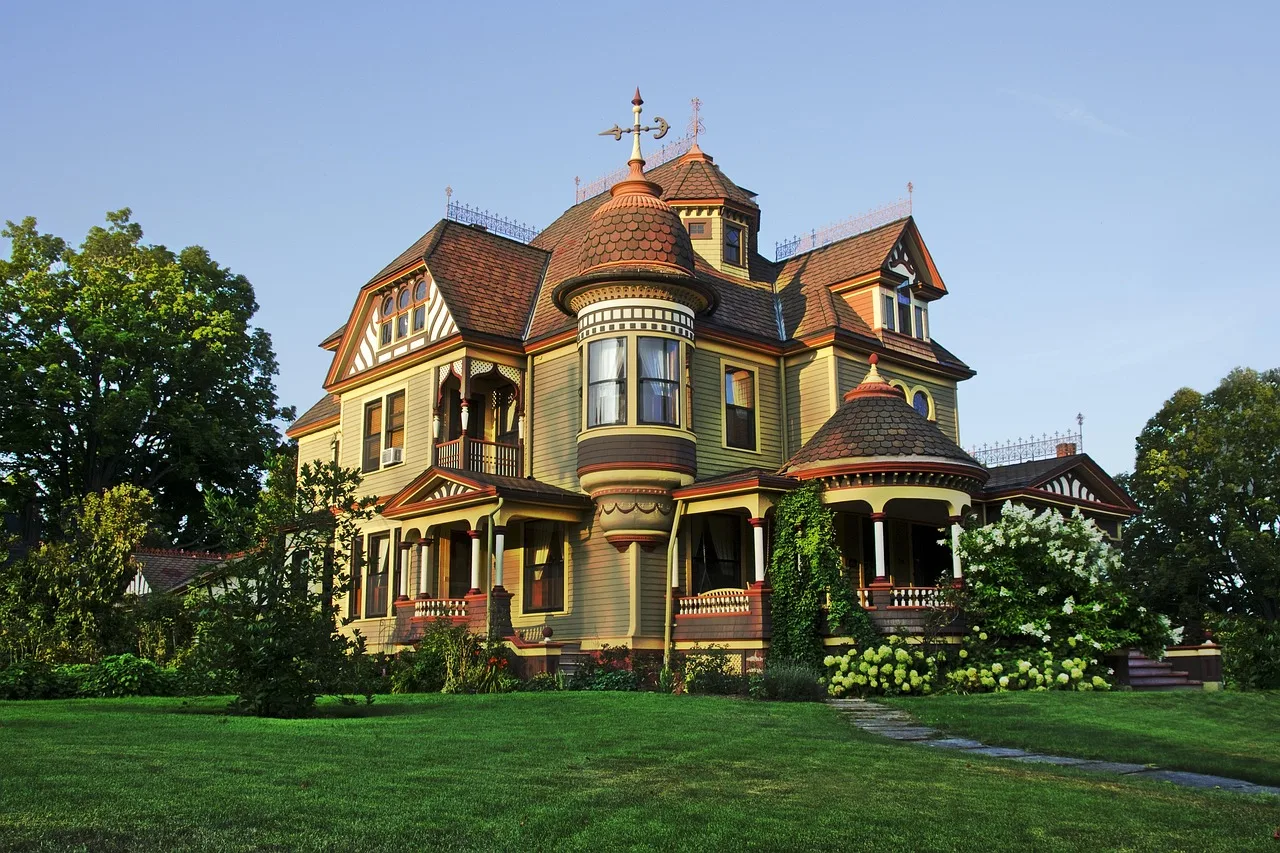
- Victorian.The body goes darker and warmer — ochre, olive, deep red, brown or mustard — with trim in a contrasting tone and a third color on the sash.
- Early-20th-century Colonial Revival and Craftsman.Cream and off-white bodies return, with sage and olive greens, earthy browns on Craftsman work, and pale blue or blue-green porch ceilings.
Across all four, the value contrast between body, trim and accent does more for the facade than the hue does.
Example: reading a 1912 porch ceiling
A house in Ohio carried four layers on its porch ceiling. The lowest was a pale blue, covered over in the 1950s. Matching it and the sash color beneath gave the facade a scheme nobody had to invent.
Sample in three places: a protected run of siding, the porch ceiling and the window jamb beside the sash. Where the layers disagree, the house was repainted in stages, and the oldest layer wins.
That house predates 1978, so any scraping falls under the EPA's Renovation, Repair and Painting (RRP) Rule. The rule requires a Lead-Safe Certified Firm and certified renovators, and it sets containment and cleanup requirements for work on pre-1978 housing.
Running a test patch
- Read the layers firsta protected run of siding, the porch ceiling and one window jamb beside the sash.
- Buy samples of the body, trim and accent colors and paint them side by side on two elevations, one in sun and one in shade.
- Leave the patches through at least four weeks of weather, then judge them from the curb and the sidewalk rather than from the ladder.
- Brush out a larger patch in the real paint before you commit, because sheen and film thickness change how a color reads on a wall.
If your house sits in a historic district, get the commission's approval of the scheme before the samples go up.
Where each one wins
Paint analysis wins with original siding, a reviewed facade, and time to wait. Era convention wins on a plain house when speed matters more than proof.
A brand historic line wins for a repeatable formula and a second gallon in three years. A consultant wins on a facade with three or four colors, where placement decides the result.
Whoever holds the brush still decides the finish. Thin coats and skipped prep ruin a good palette, and the hiring questions that separate a careful painter from a confident one are worth asking before the color is agreed.
What none of them solve
No route predicts how a color ages. Sun, salt air and freeze-thaw cycles bleach or chalk a finish within a few years, and no chip shows that. Moisture behind the siding causes more coating failure than color choice ever does.
None of the four options tell you what the paint is hiding either. Soft siding, failing gutters and rotted sill ends show up long after the color was approved.